
Seven years ago, I wrote about the eye-popping difference between retimers and redrivers. The central point was that a redriver boosts an impaired signal, while a retimer recovers the data, extracts the embedded clock, and retransmits a fresh copy of the data on a clean clock. That distinction is still accurate and directly influences design decisions; but it’s not the only factor!
On July 21, 2026, Astera Labs announced a new line of 200G/lane Smart Redriver products to complement — in the same footprint — our portfolio of 200G/lane Smart Retimers. You might be wondering: What has changed since then, and why did Astera Labs announce a new line of redriver products?
How Have Redrivers Changed Since 2019?
In my original article, I compared retimers and redrivers by looking at the capabilities that most directly affect a high-speed link: protocol participation, jitter, equalization, adaptation, diagnostics, placement, and use cases. My conclusion at the time was that although system designers benefit from having multiple options for reach extension solutions, emerging PCIe® use cases pointed to a greater need for retimers.
New in 2026: Redriver Diagnostics
In my original comparison table, I listed diagnostics as one of the clearest dividing lines between the two device types. Retimers have internal eye monitors, pattern generators, checkers, and link status monitors, while redrivers traditionally had “nothing to speak of.” At the time, that was a fair description.
That description no longer applies to every redriver on the market. Taurus Smart Redrivers have on-die microcontrollers, sensors, and signal monitoring circuitry to provide actionable diagnostics to system operators.
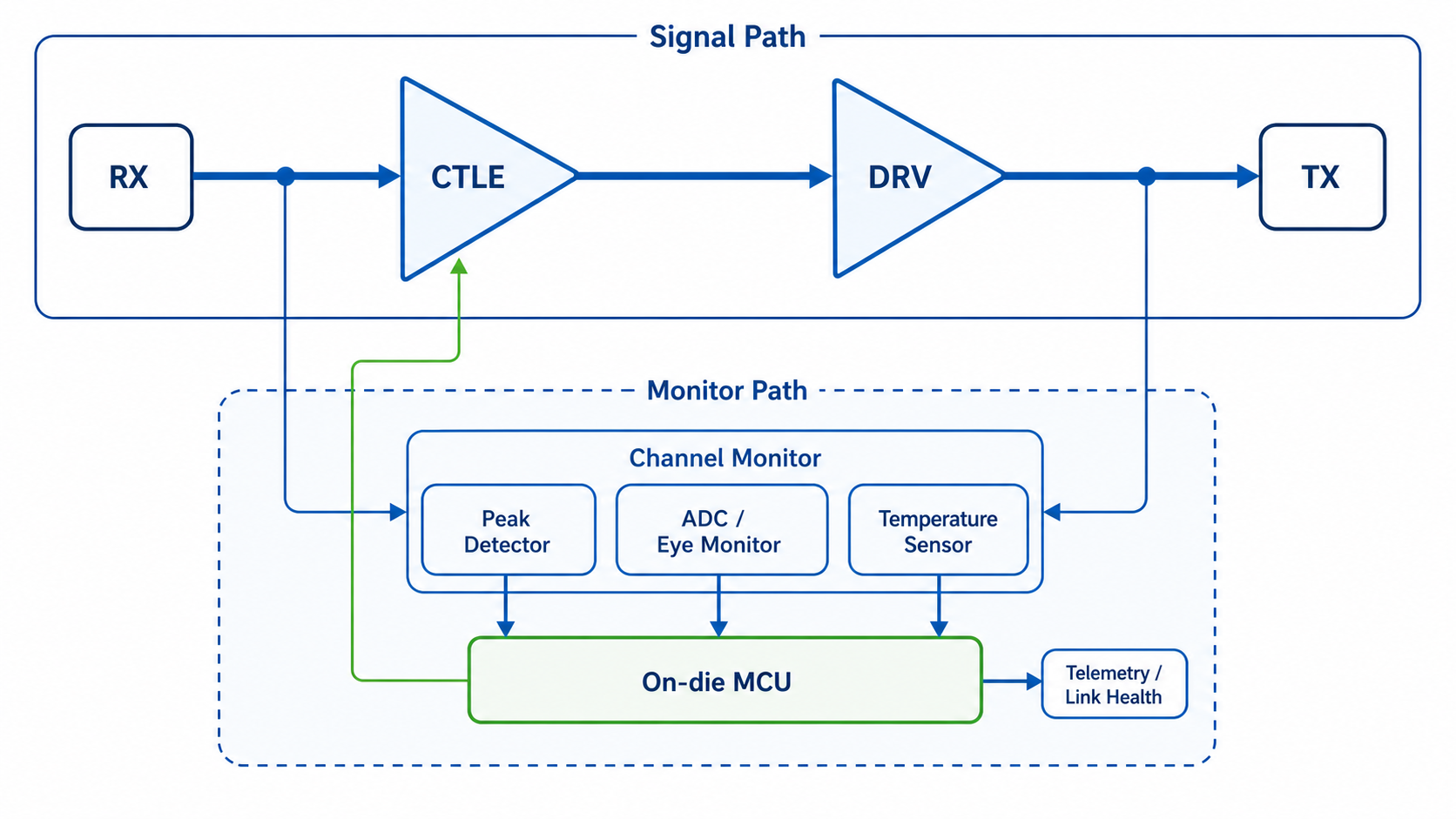
These include:
- Channel estimation: Captures the channel pulse response in hardware and estimates the frequency response and impedance discontinuity profile. Importantly, the location of a discontinuity can be estimated, which means channel connectivity issues can be diagnosed during manufacturing screening or prior to link-up in a deployed system, thereby preempting a negative customer experience and giving operators critical information about what and how to fix a problem.
- Eye monitoring: Uses post-processing to reconstruct a virtual eye diagram, giving a diagnostic view of channel conditions and signal quality without external test equipment.
- System telemetry: Loss-of-signal detection, die temperature reporting with configurable over-temperature thresholds, and voltage monitoring provide operational data. Through COSMOS, the same information supports performance and temperature monitoring, remote and dynamic firmware updates, and indications of potential failures based on real-time link health across a fleet.
- Temperature-compensating EQ: A system tuned at room temperature can over- or under-equalize when the system runs hot or cold, degrading the eye. Smart Redrivers automatically adjust EQ with temperature, holding the post-equalized channel loss steady as the system heats or cools. This lessens the burden on the link partner receivers to track interconnect loss variation over temperature.
- Link-quality monitoring: The peak detector output is used to tune the equalizer settings prior to auto-negotiation and link training so that each endpoint sees a static, linear channel. This improves link training convergence and reduces the amount of simulation and lab tuning required to arrive at an optimum setting. Once the link is running, loss-of-linearity and signal quality monitoring continue to report over- and under-boost conditions, and firmware can raise an alert before those conditions produce errors.
For a 200G/lane deployment, these features change how a redriver can be deployed and supported. They narrow the historic gap between retimers and redrivers while preserving the power and latency advantages redrivers have conventionally held over retimers.
New in 2026: Design Once, Decide Later
Channel requirements are often not finalized when a board layout is designed. A channel which was conservatively designed around a retimer sometimes turns out to meet the performance requirements with a redriver instead, and vice versa.
Taurus Smart Retimers and Smart Redrivers share the OCP Signal Conditioner Standard Footprint. With Smart Swap — Astera Labs’ feature for seamless interchange between retimer and redriver from a BoM and software integration standpoint — teams can switch between the two devices without a board redesign. When channel loss turns out higher than expected late in a program, Smart Swap reduces that discovery to a BOM change. COSMOS provides one consistent workflow to configure, validate, monitor, and deploy both device types, which keeps the qualification effort manageable when a platform uses a mix of both.
For more on the common footprint, download our white paper covering the need and applications for the standard.
How Have the Use Cases for Retimers and Redrivers Changed?
For the most difficult channels, the right choice between retimer and redriver has not changed: A retimer fully regenerates the signal, resets the jitter budget, and delivers the maximum reach extension. Taurus Smart Retimers, for example, handle 40 dB+ of insertion loss, enabling 80 dB of total channel reach end to end. A retimer is the answer when the channel requires full signal regeneration, maximum reach, or active protocol participation.
What has changed since 2019 is that a growing number of 200G links require only a moderate amount of reach extension while simultaneously being highly sensitive to power and latency. They need more than what passive copper can deliver, but less than full retiming.
A redriver serves this purpose well by equalizing the channel in the most power-efficient and latency-optimized manner possible. Taurus Smart Redrivers can extend the total channel reach by up to 23 dB with power less than a third of a retimer and pin-to-pin latency under 50 ps. Apply this power savings to hundreds of links in a rack and the benefits become substantial.
At 200G/lane, AI system designers face the formidable challenge of routing an unprecedented number of high-speed signals within rack-scale architectures while closing link budgets and minimizing power consumption and latency. Optimizations are done on a link-by-link basis, and all options — PCB material, cable gauge, signal conditioners, and more — are on the table to close link budgets in these dense backplanes, front-port channels, and a widening range of scale-up and scale-out topologies.
The Future of Signal Conditioning for 200G Systems
At 200G/lane and beyond, platform designers are pushing for signal conditioning optionality. They want to optimize each link for the right combination of reach, power, and latency without sacrificing diagnostics. No redriver solution could offer this level of flexibility and diagnostics when I wrote my original article. That’s why we built one that can.
Visit our booth at AI Infra 2026 to see a live demo of our Taurus Smart Retimers and Redrivers.